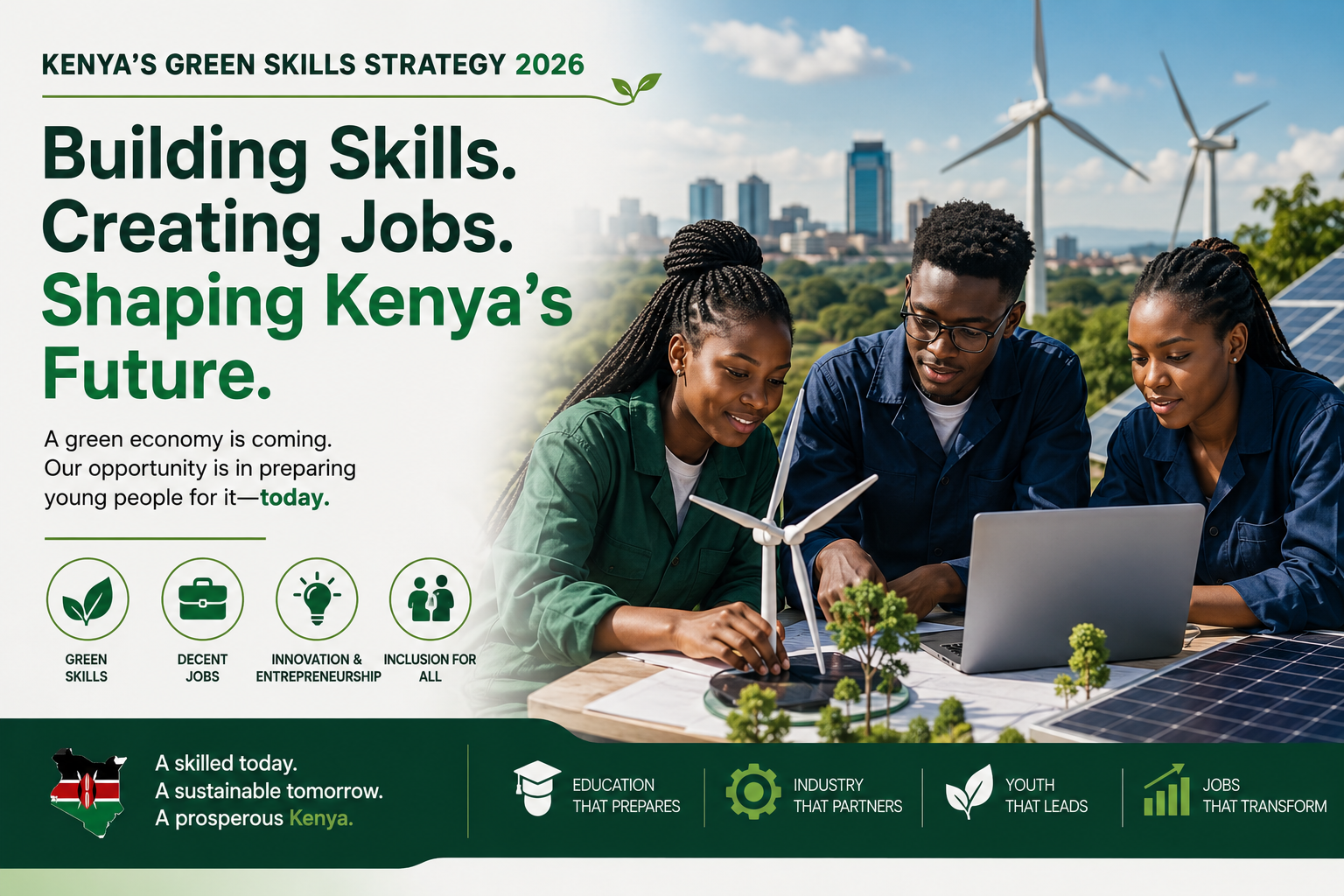
Kenya’s
Green Skills and Jobs Strategy: The Bigger Question Is Whether Our Education
System Is Ready
By Dr. Irene Kiarie | Education & Youth Development Specialist in Kenya
Kenya’s launch of the National Strategy
on Green Skills and Jobs is more than another addition to the
country’s growing collection of policies on youth, skills and employment. It
signals something much bigger. The economy (locally & globally) is
changing, and the skills required to participate in it are changing with it.
For young Kenyans, this raises a question that
goes beyond “What green jobs are available?”
The more important question is: Are we
preparing young people for the economy that is emerging, or for the economy
that is gradually disappearing? That question places green skills
firmly within the conversation about education, career guidance, employability
and the future of work.
Green
skills are not simply about the environment
When people hear “green skills,” they may
immediately think about renewable energy, climate change, recycling or
environmental conservation. Those areas matter. But the bigger picture is much
broader.
The transition towards a greener economy will
influence how we produce food, build houses, generate energy, move people and
goods, manufacture products, manage waste and use technology. That means the
green transition will not create an entirely separate category of workers
called green workers. Instead, it will increasingly change the way existing
occupations are performed.
A mechanic may need skills for electric and
hybrid vehicles. An engineer may need to understand energy efficiency. An
agricultural professional may work increasingly with climate-smart production
systems. An ICT graduate may find opportunities in technologies supporting
energy, agriculture or environmental monitoring. Even business, finance,
communication, law and education will increasingly interact with the green
economy.
The important point, therefore, is not simply to identify “green careers.” It is to understand how the transition will changing careers that already exist.
The real issue is the distance between education and the labor market
This is where Kenya’s green skills agenda becomes
particularly important. For years, discussions about youth unemployment have
often focused on whether young people have enough qualifications. But
qualifications alone do not guarantee employability. The more difficult
question is whether what young people learn is connected to what the economy
needs. A student can successfully complete secondary school, proceed to
university or TVET, graduate with a certificate or degree and still find that
the labor market has moved in a different direction. This is not necessarily a
failure of the young person. It can be a failure of alignment.
Education systems, employers, industries, policymakers and training
institutions must continuously ask:
What capabilities will Kenya need five,
ten or fifteen years from now?
The green transition makes this question
impossible to ignore especially with the introduction of the Competency based
curriculum (CBC/CBE).
This
is where career guidance becomes more important
Kenya is already asking learners to make
important decisions about their future earlier in their educational journey. Under
the Competency-Based Education framework, career pathways and subject choices
are becoming increasingly important.
But career guidance cannot simply mean helping a
learner choose between becoming a doctor, lawyer, teacher or engineer. The
world of work is becoming more fluid. A more useful approach would help
learners understand:
·
how industries are changing;
·
what skills different sectors will need;
·
which occupations are emerging;
·
which existing occupations are being
transformed;
·
what competencies are transferable across
careers;
·
and where their interests and abilities
intersect with future opportunities.
In other words, career guidance must move from career selection to career navigation. A young person should not only ask: “What do I want to become?” They should also learn to ask: “How is this field changing, and what will I need to remain relevant?” That is a much more powerful question in a rapidly changing labor market.
The
green transition also changes the meaning of employability
There is another lesson here. The future of work
will not be determined by technical qualifications alone. Young people will
increasingly need a combination of:
Technical
competence + digital capability + adaptability + problem-solving + innovation +
entrepreneurial thinking.
This is especially important because the jobs of the future may not always exist in the same form when a learner begins their education. A young person entering university today could graduate into an economy that looks significantly different from the one they entered. This means that education should not only prepare people for a particular job. It should prepare them to continue learning as jobs change. That is perhaps one of the most important implications of the green transition.
TVET
has an opportunity to move from the margins to the center
Kenya's green transformation also presents an
opportunity to rethink how we perceive technical and vocational education. The
green economy will require people who can build, install, repair,
operate, maintain, design and adapt new technologies and systems. These
are practical capabilities.
And that places TVET institutions in a
potentially powerful position. But this opportunity will only be realized if
training institutions remain closely connected to industry. A curriculum can be
well designed on paper and still produce graduates whose skills do not match
workplace realities. The real test should therefore be: Can a graduate
use what they have learned to solve a real problem in the economy? That
question should be at the heart of skills development.
The
opportunity is bigger than employment
Another important dimension is entrepreneurship. A green economy does
not only create jobs within established organizations. It can also create space
for young people to develop businesses around emerging needs. Think about the
possibilities created when new technologies, changing consumer behavior and
environmental challenges intersect.
Waste becomes a resource. Energy efficiency
becomes a business opportunity. Climate-smart agriculture creates new services
and value chains. Clean mobility creates demand for new technical expertise. Digital
technologies create new ways of monitoring, managing and financing
environmental solutions. The question for young people therefore should not
only be: “Who will employ me?” It should increasingly include:
“What problem is emerging, and what can I build around it?”
But
policy alone will not create a green workforce
This is perhaps where the greatest caution is
needed. A national strategy can provide direction, but implementation
determines whether that direction becomes reality. The success of Kenya's green
skills agenda will depend on
·
What happens inside classrooms, laboratories,
workshops, universities, TVET institutions and workplaces
·
Whether employers participate meaningfully in
training.
·
Whether curricula keep pace with technological
and economic change.
·
Whether young people can access practical
experience.
·
Whether institutions can identify emerging
skills needs quickly enough.
And critically, it will depend on whether opportunities reach young people beyond the most connected urban populations. A green transition that creates opportunities only for those who already have access to quality education, technology, networks and finance would risk reproducing existing inequalities in a new form. The transition must therefore be green, but also inclusive.
What should Kenya be thinking about next?
The strategy gives Kenya an important opportunity
to connect conversations that are often treated separately - Education policy, Career
guidance, Skills development, TVET, Youth employment, Industry needs, Entrepreneurship,
Climate action, Labor mobility. These are not isolated
conversations. They are parts of the same system. A young person's journey from
school to employment is shaped by all of them.
This is why the green skills agenda should not be
left solely to environmental or labor sector conversations. It belongs equally
in discussions about what we teach, how we guide learners, how we
design pathways, how we connect education with industry and how we prepare
young people for an uncertain future.
The
bigger question for Kenya
Perhaps the most important lesson from the
National Strategy on Green Skills and Jobs is not about which green jobs young
people should pursue. It is about whether Kenya can build an education and
skills system that anticipates change rather than reacts to it.
The green transition is only one example.
Artificial intelligence, automation, digitalization,
demographic changes and evolving global labor markets will also reshape the
demand for skills. If we respond to every change by creating a new course, a
new programme or a new policy after the disruption has already happened; we
will always be playing catch-up. The more ambitious goal should be to build a
system capable of continuously asking:
What is changing in the economy
and globally, and what does that mean for the way we prepare our young
people?
That is the bigger conversation Kenya needs. The
green economy is not simply asking us to create green jobs. It is
challenging us to rethink how we prepare people for work itself. And
perhaps that is the most important opportunity hidden within Kenya's green
skills agenda.
A final thought
For young people, the message should not be that
everyone must suddenly pursue a “green career.” The message is more useful than
that:
Whatever career you choose, understand
how the world around that career is changing. Build skills that remain
valuable. Keep learning. Pay attention to where the economy
is going, not only where it has been.
For educators and policymakers, the
responsibility is even greater. We must ensure that the choices young people
make today do not prepare them only for yesterday's economy.
Kenya's green transition is therefore not
just a jobs agenda. It is a test of whether our education and skills systems
can keep pace with the future.
About
the Author
Dr.
Irene Kiarie is an Education and Youth Development
Specialist with over 15 years of experience in education and teaching, with
interests in career guidance, youth employability, school-to-work transitions,
competency-based education, future skills and education systems. Through Youth
Insights, she explores how changes in education, skills and labor markets
affect Kenyan youth and the institutions that prepare them for the future.