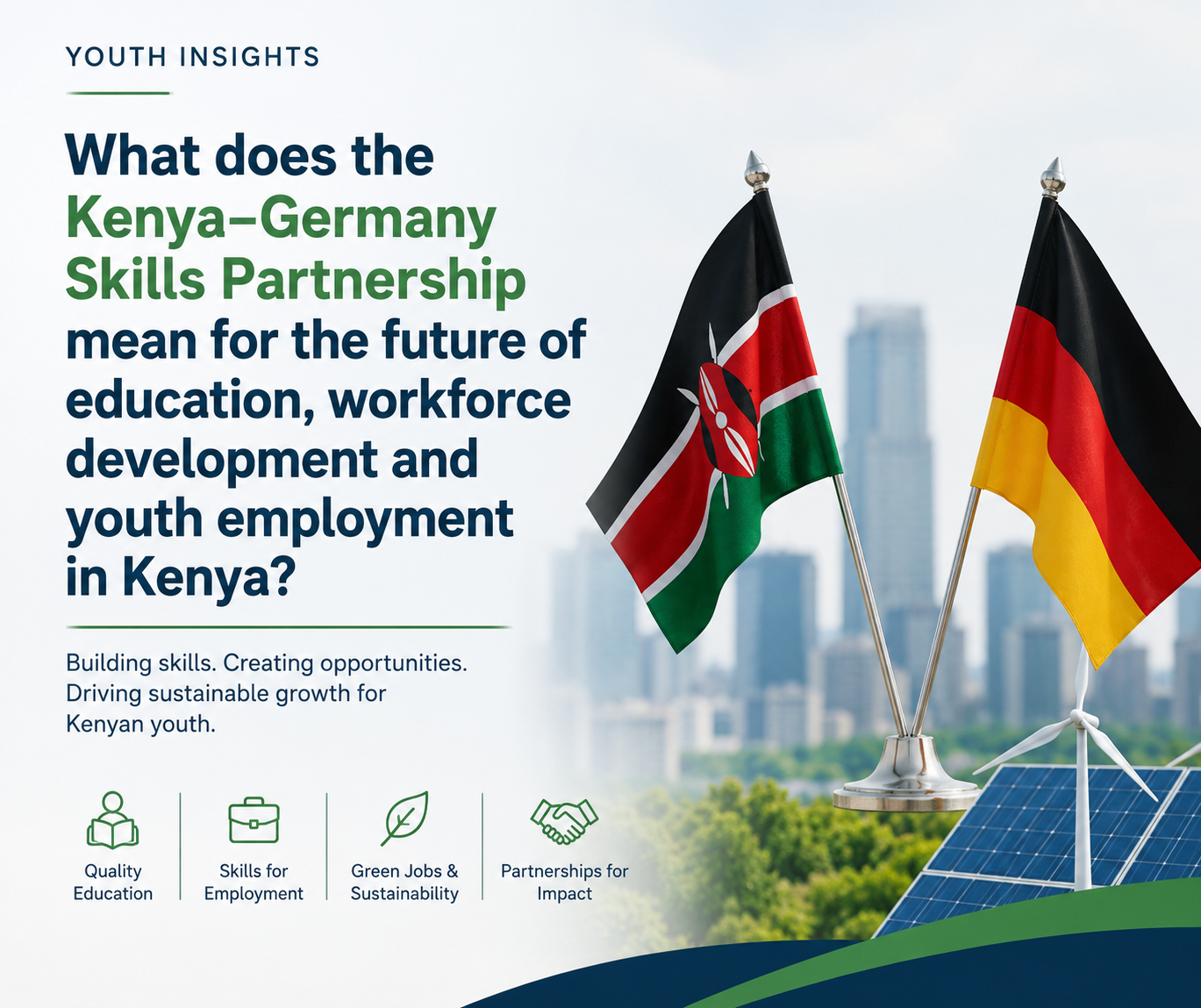
YOUTH INSIGHTS BRIEF
What does the
Kenya-Germany Skills Partnership mean for the future of education, workforce
development and youth employment in Kenya?
A reflection from the 4th Skill up Africa Summit • World Youth Skills Day 2026
Dr. Irene Kiarie
Education & Youth Development Specialist
|
THE CENTRAL QUESTION |
Executive
Summary
On
World Youth Skills Day 2026, I attended the 4th Skill Up Africa Summit at the
Kenyatta International Convention Centre (KICC), where government, industry,
development partners, educators and young people gathered around the future of
skills and employment in Kenya. The summit provided a useful lens through which
to examine the growing Kenya-Germany skills partnership and what it could mean
for Kenya’s education and workforce systems.
Three
policy instruments were highlighted at the summit: the National Strategy on
Green Skills and Jobs in Kenya 2026-2031, the National Policy on Business
Process Outsourcing, and the National Strategy for the Transformation of the
Informal Economy. Together, these initiatives point to a broader policy shift:
Kenya is increasingly asking not only how to train young people, but how to
connect training with industry, enterprise, technology and actual
opportunities.
The
Kenya-Germany relationship adds an international dimension to this shift.
German Ambassador Sebastian Groth highlighted cooperation on technical
training, workplace-based learning and safe labour mobility as ways of
connecting education more directly with industry. The ambition should therefore
extend beyond individual mobility to the institutions, employers and training
systems that make skills productive.
This brief argues that the partnership should be understood as a school-to-work and skills-to-production agenda rather than simply a pathway to jobs in Germany. Its long-term value to Kenya will depend on whether it strengthens TVET and higher education, expands work-based learning, improves recognition of competence, responds to employer demand, supports local production and entrepreneurship, and prepares young people for both local and global labour markets.
|
KEY MESSAGE |
1.
From a Skills Summit to a Bigger Education Question
The
4th Skill Up Africa Summit was more than a conversation about employability. It
brought together several parts of the system that are often discussed
separately: education and training, employers, government policy, international
cooperation, youth employment, green transition, digital services and the
informal economy. That convergence matters.
The
summit’s policy announcements reflected this wider agenda. The National
Strategy on Green Skills and Jobs seeks to prepare workers for opportunities
arising from the green transition; the BPO policy responds to opportunities in
digital and internationally traded services; and the strategy for transforming
the informal economy addresses the skills and livelihoods of a large part of
Kenya’s workforce.
The
central question emerging from these developments is therefore not simply: How can more young Kenyans get jobs? It
is: How can Kenya build an education and
workforce development system that connects learning to productive work,
enterprise and economic transformation?
2.
What the Kenya–Germany Skills Partnership Signals
The
Kenya–Germany relationship provides a practical example of how international
cooperation can connect education, industry and labour markets. Ambassador
Sebastian Groth pointed to technical training, workplace-based learning and
safe labour mobility as areas of cooperation. He also stressed the importance
of investing not only in individual training, but in institutions and employer
partnerships that enable skills to translate into real opportunities.
International
labour mobility can easily be reduced to a simple narrative: Kenyan youth are
trained, then leave for jobs abroad. A more strategic interpretation is
possible. Mobility can become one component of a wider skills ecosystem in
which young people acquire competence, workplace experience, international
exposure and professional networks, while Kenya simultaneously strengthens its
own training institutions, industries and productive capacity.
The
broader economic relationship also matters. Public reporting has put the number
of German companies operating in Kenya at around 120. This presence creates a
potential platform for stronger employer-led training, apprenticeships,
technology transfer, local value addition and industry–education partnerships.
|
A STRATEGIC SHIFT |
3.
Green Skills Are Becoming Core Workforce Skills
The
phrase ‘green skills’ can sound like a narrow environmental concept. In
reality, it cuts across sectors. Green skills include the technical, digital
and professional capabilities needed to support renewable energy, sustainable
agriculture, energy efficiency, e-mobility, circular production, resource
efficiency, climate adaptation and other forms of sustainable economic
activity.
For
Kenyan youth, green skills should not be treated as a separate career lane
reserved for environmental specialists. A young person studying electrical
engineering, agriculture, construction, manufacturing, ICT, transport or
business can increasingly add a green dimension to that profession.
|
Sector |
Examples of green / future skills |
Potential opportunity |
|
Energy |
Solar PV, energy efficiency, battery systems,
smart energy |
Renewable energy installation, maintenance and
enterprise |
|
Agriculture |
Climate-smart farming, irrigation, precision
agriculture |
Agritech, sustainable production and value
addition |
|
Construction |
Energy-efficient buildings, sustainable materials,
HVAC |
Green construction and building services |
|
Manufacturing |
Resource efficiency, automation, circular
production |
Local manufacturing and industrial upgrading |
|
Transport |
E-mobility, charging systems, efficient logistics |
Emerging mobility and transport services |
|
Digital |
Data, GIS, AI and digital tools for sustainability |
Climate data, smart systems and digital services |
Kenya’s
green skills agenda is therefore also an industrial and education agenda. It
asks training institutions to anticipate emerging sectors, employers to
participate in curriculum and workplace learning, and young people to see
technical competence as a foundation for both employment and enterprise.
4.
The Skills Mismatch: Why Graduates and Employers Can Both Be Right
One
of the most important insights from the summit is the apparent contradiction
between youth unemployment and employer reports of skills shortages. Federation
of Kenya Employers (FKE) Executive Director and CEO Jacqueline Mugo noted that
companies can struggle to fill positions even while qualified young people
struggle to find work.
An
FKE survey of about 700 enterprises conducted in 2025 found gaps in technical,
digital and interpersonal skills. Nearly 60% of respondents expressed a
preference for technically skilled workers.
|
THE REAL PROBLEM |
A qualification can show that someone
completed a programme. It does not automatically demonstrate that the person
can perform a task in a real workplace, use modern equipment, solve problems,
communicate professionally or adapt to changing technology. |
This is why the summit’s emphasis on workplace-based
learning matters. Internships, apprenticeships and industrial attachments are
most valuable when they are structured learning experiences with clear
competencies, supervision and meaningful work—not simply short periods spent at
a workplace.
5.
From Employability to Production: A More Ambitious Goal for Kenyan Youth
Perhaps
one of the most important messages for Kenya’s education system is that skills
should not be viewed only as a ticket into employment. Principal Secretary for
TVET Dr Esther Muoria challenged young Kenyans to consider how they could
produce locally some of the goods, components and technologies that Kenya currently
imports.
This
reframes the question from “How do I get
a job?” to “What can I make, solve
or build?”
That
distinction is critical for youth development. A skills system that produces
only job seekers may struggle to absorb growing cohorts of graduates. A skills
system that also develops innovators, technicians, entrepreneurs and
manufacturers can contribute to job creation itself.
|
THE OPPORTUNITY FOR TVET |
6.
What This Means for the Future of Education in Kenya
Move
from curriculum delivery to labour-market relevance: Institutions need current
information on what employers and emerging sectors require. Curriculum review
should be connected to labour-market intelligence, industry input and
technological change.
Make
workplace learning a core part of education: Industrial attachments,
internships and apprenticeships should be treated as structured learning
pathways with defined competencies and assessment-not optional add-ons.
Strengthen
technical and digital competence together: Technical
workers increasingly need digital literacy, data skills and the ability to work
with automation and smart systems. Digital competence should complement, not
replace, hands-on expertise.
Recognise
competence wherever it is acquired: People develop valuable skills in
workshops, farms, family businesses and informal enterprises. Recognition of
prior learning can make these competencies visible, portable and easier to
build upon.
Prepare
learners for both employment and enterprise: Education should equip young
people not only to apply for jobs but also to identify problems, develop
products, build services and create enterprises.
Give
young people a voice in the system: Young people should participate in
curriculum conversations, training evaluations and decisions about employment
and enterprise support. Systems designed for youth should be built with youth.
7.
What Kenyan Youth Can Do Now
·
Build one strong technical or
professional skill and add digital competence to it.
·
Look for practical experience - internships,
apprenticeships, projects, volunteering, enterprise work or supervised industry
exposure.
·
Learn how your chosen sector is being
transformed by climate change, digitalisation, automation and new technologies.
·
Develop communication, teamwork,
problem-solving, professionalism and adaptability alongside technical
competence.
·
Consider German language learning if
Germany is part of your career plan, but do not confuse language ability with
employability; the underlying technical competence still matters.
·
Build a portfolio that demonstrates what
you can do: projects, prototypes, case studies, practical work, certifications
and evidence of problem-solving.
·
Look beyond migration. Ask what skills
can help you build a business, produce locally, provide services or solve a
Kenyan problem.
8.
What Institutions and Policymakers Should Consider
|
Stakeholder |
Priority action |
|
Government |
Use labour-market intelligence to align training
investment with emerging sectors; track outcomes beyond enrolment and
graduation. |
|
TVET
institutions |
Expand employer partnerships, modernise equipment,
strengthen workplace learning and embed entrepreneurship and green skills. |
|
Universities |
Connect academic programmes with industry,
emerging technologies, applied research and employability; strengthen
pathways into enterprise. |
|
Employers |
Move from asking for ‘job-ready’ graduates to
actively participating in training, apprenticeships, mentoring and workplace
learning. |
|
Development
partners |
Invest in systems and institutions as well as
individual trainees, including equipment, curriculum, certification,
labour-market data and employer networks. |
|
Youth
organisations |
Create mechanisms for young people to contribute
to policy design, curriculum reviews and assessment of skills programmes. |
9.
Conclusion: Beyond Jobs in Germany
The
Kenya–Germany skills partnership comes at an important moment for Kenya. The
country is simultaneously reforming education, expanding TVET, pursuing a green
transition, promoting digital services and confronting persistent youth
unemployment. The partnership provides a practical opportunity to connect these
agendas.
But
the measure of success should not be the number of young people who obtain jobs
abroad alone. Success should also be visible in stronger Kenyan institutions,
better workplace learning, internationally credible competencies, more
productive industries, local manufacturing, new enterprises and young people
who can move confidently between education, work and entrepreneurship.
Kenya
should therefore pursue a dual ambition: prepare
young people for global opportunities while strengthening their ability to
create value at home.
The
deeper lesson from the Skill Up Africa Summit is that the
education-to-employment pipeline cannot be fixed by education institutions
alone. Government, employers, training institutions, development partners and
young people must share responsibility for building it.
|
A FINAL REFLECTION |
About
the Author
Dr. Irene Kiarie
is an Education and Youth Development Specialist with over 15 years of
experience in education and teaching, with interests in youth employability,
school-to-work transitions, competency-based education, future skills and
education systems. Through Youth Insights, she explores how changes in
education, skills and labour markets affect Kenyan youth and the institutions
that prepare them for the future.
Publication
Note
This
brief is an independent analysis informed by observations from the 4th Skill Up
Africa Summit and publicly available information from the United Nations in
Kenya and other cited sources. It is intended to stimulate evidence-informed
discussion and does not represent the official position of the Government of
Kenya, the Government of Germany, the United Nations, or any other institution
mentioned.
Sources
and Further Reading
[1]
United Nations in Kenya (2026). Kenya strengthens
practical path at the centre of youth employment. 15 July 2026. https://kenya.un.org/en/319479-kenya-strengthens-practical-path-centre-youth-employment
[2]
United Nations in Kenya. Sustainable Development Goal 8:
Decent Work and Economic Growth. https://kenya.un.org/en/sdgs/8/key-activities
[3]
United Nations in Kenya. Sustainable Development Goal 4:
Quality Education. https://kenya.un.org/en/sdgs/4/key-activities
[4]
The Star (2025). Jobs in Germany up for grabs, says
ambassador. 14 August 2025. https://www.the-star.co.ke/news/big-read/2025-08-14-jobs-in-germany-up-for-grabs-says-ambassador
[5]
Citizen Digital (2023). Josef Seibel brings German quality
Shoes to Kenya. 28 January 2023. https://citizen.digital/news/josef-seibel-brings-german-quality-shoes-to-kenya-n313394