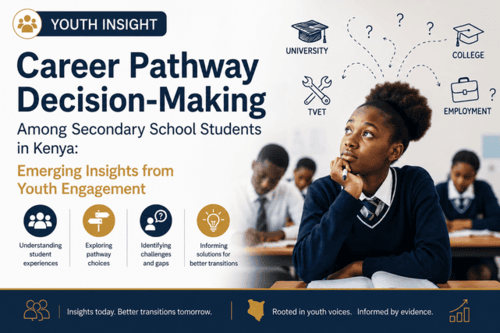
Career Pathway Decision-Making among CBE Senior Secondary School Students in Kenya: Emerging Insights from Youth Engagement
1. Introduction
Ongoing education reforms in Kenya, particularly the transition to the Competency-Based Education(CBE) curriculum, have introduced earlier and more structured career pathway decisions for students. While these reforms aim to align education with skills development and future opportunities, there is growing concern about how effectively students are navigating these decisions in practice.
This brief presents emerging insights drawn from direct engagement with secondary school students through mentorship and career guidance initiatives. The aim is to highlight key challenges experienced at the student level and to contribute to ongoing discussions on strengthening career guidance and transition systems.
2. Context
Students are increasingly required to make important academic and career-related decisions at earlier stages of their education, including subject and pathway selection before entering senior secondary levels. Under this curriculum, students must choose one of the three pathway systems (STEM, Arts/Sports, and Social Sciences)
These decisions are expected to:
- Reflect individual interests and strengths
- Align with future career opportunities
- Support long-term progression into higher education or the workforce
However, the systems supporting these decisions, particularly career guidance structures, are still evolving.
3. Key Insights from Student Engagement
a) Limited Understanding of Career Pathways
Many students demonstrate only a basic or fragmented understanding of available pathways and their long-term implications. Common patterns include:
- Selecting pathways based on perceived difficulty rather than alignment
- Limited awareness of emerging or non-traditional career options
- Confusion about subject combinations and future requirements
b) Decision Making Under Uncertainty
Students are often making high-stakes decisions without sufficient information or structured support. As a result:
- Choices are influenced by parents, peers, trends or assumptions
- Students express low confidence in their decisions
- Some experience uncertainty shortly after selecting pathways
c) Inconsistent Access to Career Guidance
Access to career guidance varies significantly across schools and regions. Observed gaps include:
- Limited structured guidance programmes
- Over-reliance on one-off talks rather than continuous support
- Lack of trained personnel dedicated to career counseling
d) Misalignment between Aspirations and Information
Students often have aspirations but lack the information needed to connect them to realistic pathways. This results in:
- Disconnect between ambition and preparation
- Under informed subject and course selection
- Missed opportunities due to lack of awareness
4. Implications for Education Systems
These insights point to a broader systemic challenge:
Expanding choice without strengthening guidance increases the risk of misaligned decisions.
Without adequate support structures:
- Students may follow pathways that do not match their strengths or goals
- Transitions into higher education or employment become more difficult
- Inequities in access to information and support may widen
5. Opportunities for Strengthening Practice
Based on these observations, several areas emerge for consideration:
a) Strengthening Career Guidance Systems
- Introduce structured, continuous career guidance programmes
- Build capacity for trained career counselors within schools
b) Integrating Career Awareness into Learning
- Embed career exposure within subject teaching
- Provide practical insights into how learning connects to real-world applications
c) Supporting Informed Decision-Making
- Develop tools and frameworks to guide students through pathway selection
- Provide accessible, up-to-date information on education and career options
d) Leveraging Student Insights
- Incorporate student experiences into programme design and policy discussions
- Establish feedback mechanisms to capture ongoing challenges
6. Conclusion
As education systems continue to evolve, attention must be given not only to curriculum structure, but also to how students are experiencing and navigating these changes. Strengthening the systems that support decision-making, particularly career guidance, will be essential in ensuring that expanded educational opportunities translate into meaningful and successful transitions for young people.
7. About the Author
Dr. Irene Kiarie is an education and youth specialist with over 15 years of experience across teaching, research, and youth mentorship. She is the Founder of Youth Equipped, that supports young people in school-to-work transitions, career guidance systems, and the alignment between education pathways and real-world outcomes.